|
|

 hoy! And thanks for dropping anchor. I’m proud of this website and we spend quite a bit of time and effort to keep it fresh and up-to-date. However I do appreciate that with nearly 150 pages to navigate it’s hard to keep up with new material that’s posted. This page will list all new material as soon as it’s added so you can check it out from time to time and not miss out...
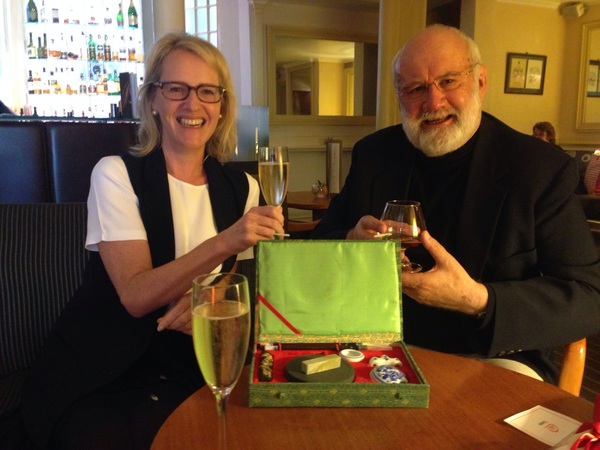
As always, I welcome your suggestions for new content so please do get in touch. And if you have any personal submissions for Shipmates Ships, Readers Letters or Shipmates Album, send ’em along. And if you think I look cold in this photo, I was! Kathy & I had shipped aboard for a square-rig voyage across the Irish Sea and we certainly had a taste of what a bitter nor’easterly can bring
May 10 I seem to have started something with my last entry! Thanks to the many Old Salts who responded with further suggestions for the origins of the nickname “Pompey” for Portsmouth. Among them:-
- A merry sailor’s slurred pronunciation of Portsmouth Point (in Kydd's day the area boasted many taverns popular with sailors) came out as “Pompey”.
- Ships entering Portsmouth harbour made an entry in the ships log “Pom. P.” as a reference to Portsmouth Point.
- La Pompee was a captured French ship moored in Portsmouth harbour and used as a prison hulk during the Revolutionary and Napoleonic Wars.
- There is apparently a Yorkshire term “pompie” for a prison or house of correction, but in what direction did this term go?.
- Volunteer firemen in the eighteenth century, known as “pompiers” (pumpers), would have been seen on Southsea Common, in Portsmouth.
Any more out there? Keep ’em coming...
May 7 As I said in my Author’s Note forVictory, I spent a week there on location research for the book. Of course the focus for the trip was HMS Victory herself but Kathy and I also took time to revisit Old Portsmouth, much of which is little changed from Kydd’s day. A fascinating walk through history which I highly commend. Most people who have visited this city on England’s south coast have heard its nickname “Pompey”. Just how this come about has been the subject of many a sailor’s dit. Take your pick – I like the last one best...
-
In 1781 a group of Portsmouth-based sailors scaled Pompey’s Pillar near Alexandria, Egypt and became known as the “Pompey Boys”.
- Portsmouth has been a port since Roman times, with nearby Portchester as a Roman military base. When the port started to be developed locals nicknamed it Pompey, because Pompeii was well known for its Roman ruins.
- The pomp and ceremony connected with the Royal Navy at Portsmouth led to the adoption of the nickname.
- Bombay was part of the wedding gift of Catherine of Braganza to Charles II. Portuguese seaman saw a resemblance between the two ports and called Portsmouth “Bom Bhia” which became Anglicised to Pompey.
- Legend has it that a snoozing, drunken sailor interrupted a lecture given in Portsmouth on the Roman Empire given by naval temperance worker, Dame Agnes Weston, founder of the Royal Sailors Rests, "Aggie westons". Upon hearing that an emperor of that name had died, the sailor shouted out “Poor old Pompey”.
April 30 In Kydd’s day it was certainly a tough life at sea – and many who set forth on the bounding main never returned. Perhaps surprisingly, the majority of those who died at sea did not meet their maker in fierce engagement with the enemy but in other ways. During the French and Napoleonic Wars, for example, some 100,000 men in the Royal Navy died ‐ 6.3% from enemy action, 12.2% from shipwreck and other disasters and a whopping 81.5% from disease or accident. I reflected on these figures recently when I was contacted by Carl Jewett of the Mesothelioma Center in the States to alert me to an excellent website on a modern sea hazard which was there when I was at sea but not present in Kydd’s day. Although a rare form of cancer, mesothelioma is a particularly nasty one that attacks the lining of the lungs and heart. A number of naval veterans around the world have been struck down with the disease because of exposure to asbestos during their time working in naval dockyards or in steam ships at sea, particularly in the period from the 1930s–1970s, including several of my own former shipmates in the Royal Australian Navy. Measures have now generally been taken to eliminate exposure but for some their previous exposure to asbestos is a ticking time bomb. Check it out for yourself.
April 26 Congratulations to all the winners of last month’s competitions. One of the contest questions asked what was the name that Nelson was called as a boy and of course it was Horace. His mother’s brother Captain Maurice Suckling famously said, when he learned his nephew was to join the Royal Navy at the age of twelve, “What has poor Horace done, who is so weak, that he, above all the rest, should be sent to rough it out at sea? But let him come and the first time we go into action a cannon-ball may knock off his head and provide for him at once”. It is thought that Nelson did not like the name Horatio, which was a family name on his mother’s side, and at home the family called him Horace. Even in later life to most people he was simply Nelson – or, of course, My Lord. Looking down the years since his tragic death, however, Lord Horace Nelson does not have quite the same ring of greatness as Horatio Nelson....
April 19 The French Navy page – now added to World’s Navies. Having just seen the proof copies of Victory my mind is somewhat focused on the French Navy during the time of Trafalgar. I can’t help but think that historians have not been kind to Villeneuve, the French Commander, suggesting that his decision to leave Cadiz and give battle in October 1805, which led directly to the grand battle, was provoked by some kind of wounded vanity when Villeneuve had learnt that another officer had been sent to take over from him. But I have quite some sympathy with the man’s personal tragedy. He did his duty even though he believed it was futile to go against the British fleet, and the poor man clearly wished he had died a hero, like Nelson, in battle. Instead he left this world, alone, in a hotel in Rennes. A verdict of suicide was recorded but I have my doubts...
April 12 I’m always delighted to hear about libraries around the world putting on displays of my work. The latest was at Stratford Public Library in Prince Edward Island, Canada. PEI is where Kydd had his adventure involving a carved chough, a trip in a birchbark canoe, a humble Irish woman and ended with his proud possession of a splendid fighting sword.
April 7 Work on the World's Navies individual pages progresses apace. Could it be this has been a wet and miserable Easter weekend? Have added the Canadian Navy, the Royal Navy and the United States Navy – as well as the navies of China and Taiwan. As I worked on these new pages with my webmaster I was reminded of my time in Hawaii in 1985 as liaison officer to the USN. Happy days! And those great steaks...But for now it’s back to the next Kydd book for a while. But do check in from time to time to see what’s new on the site
April 6 Kathy and I had the pleasure of meeting Canadian Bob Squarebriggs back in 2002 when we visited Halifax on location research for Quarterdeck, and Bob’s wonderful gift to us of a half model of Artemis is greatly treasured in our home. Bob took a young lad, Ryan Dickson, under his wing two years back as an apprentice modeller and Bob has kept me up-to-date with his progress. I’ve just put a photo on the site of the two of them proudly displaying Ryan’s first finished model, built completely from scratch. By the way, the model you can see on the wall is one Bob made of Tenacious!
April 4 As well this Easter Weekend I’ve started expanding the World’s Navies page with further, individual pages on each of the navies, starting with the Royal Australian Navy in which I served and the Royal Danish Navy that I later worked closely with. Just click on Australia or Denmark to get to the new pages. And I’ll work my way through the rest over the next few weeks – it’s my personal collation but suggestions or pictures would be welcomed.
April 2 Last week one of my readers said she really enjoyed reading my Author’s Note at the end of each book – and suggested that I put them on my website. Now why didn’t I think of that before... You can find them now at the side of every KYDD book page, but for now here they are together: Kydd, Artemis, Seaflower, Mutiny, Quarterdeck, Tenacious, Command, Daughter, Treachery, Invasion.
|