|
|
American model maker Clayton Johnson is constructing what will probably be the most accurate ever model of the Vasa
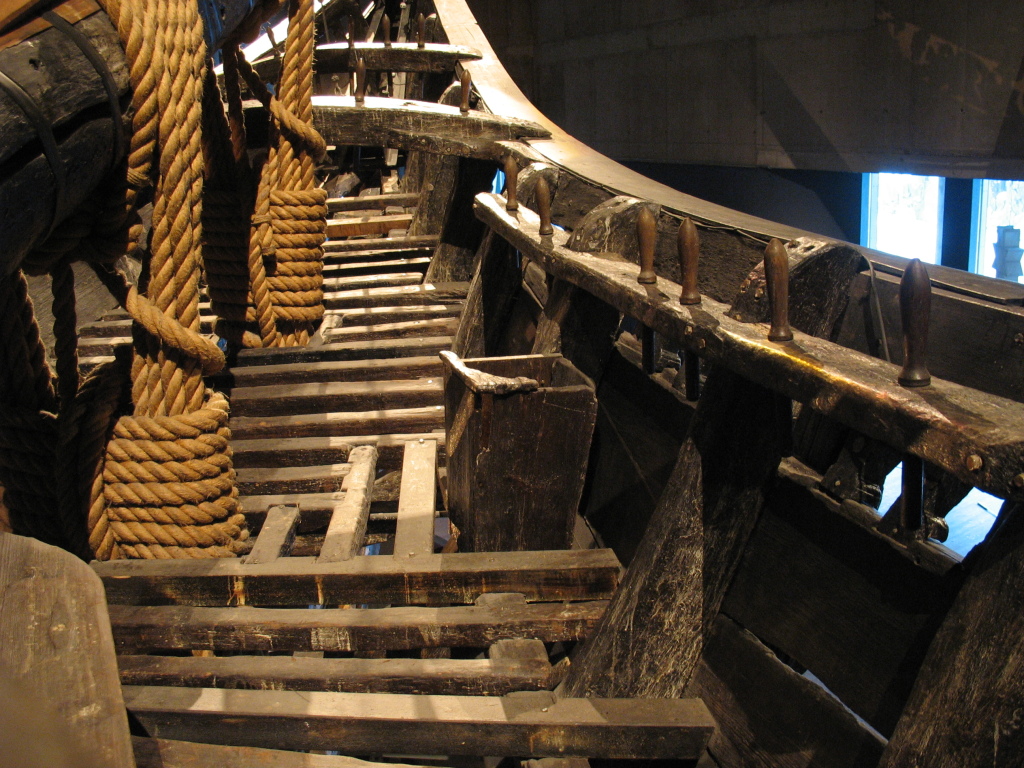
Sweden's royal ship, Vasa, sank on her maiden voyage on August 10th, 1628. She was discovered in 1956, and following a massive marine archaeological recovery programme she broke the surface of Stockholm harbour in 1961 after 333 years on the sea bottom. Now the vessel is the stunning centrepiece of the Vasa Museum in Stockholm.
he Vasa is not merely a ship – she is also an art treasure. Around 700 sculptures and ornaments decorate the warship. Sea water has taken its toll on their appearance; in 1628 Vasa would have been blazing in bright colours of gold, green, red and blue.
American modeller and scientist Clayton Johnson, who carved the figurehead for the model of Teazer built by John Thompson, has undertaken the heroic task of recreating Vasa in all her splendour on the day she was lost. Although there is a fine 1:10 scale model of Vasa in the museum, Clayton's model is carried out in full frame, is more accurate in the armament and includes a keel. Fred Hocker, director of research at the Vasa Museum, considers Clayton's model, still a work in progress, to be the most accurate in the world...
Clayton finished the hull section of his Vasa model in mid-May 2009, four years after he began his model. After a short break he's going to start on the rigging. Due to its complexity it will be a number of years before the model is finally completed – Clayton has promised to keep us posted ...
He talks about the project to date:
“The origins of the Vasa model go back to when I was a very young child, probably of 8 or 9 years, and my fascination with historic ships began. My father was an enlisted man in the U.S. Navy for a time and my grandfather spent a whole career in the U.S. Navy. There were always books lying around the house that were nautical in nature.
Even though I had never gone to sea, and spent my youth as a farm boy, my interest was sparked. One particular book called ‘Men, Ships, and the Sea’ contained a compilation of nautical articles from National Geographic. One of these explained some aspects of the archaeology of Vasa. I was fascinated and remember to this day the very inaccurate, although still impressive, painting that represented Vasa in the introduction.
This book was produced before they had started to put Vasa back together in 1973. I remember pictures of the head diver on the Vasa project, Per Edvin Falting eating 333-year-old butter which inflamed his mouth! Also giving me inspiration was the fact that my father built several plastic ship models of clipper ships such as Cutty Sark and Thermopylae. I started building ship models around the age of 10 and have continued ever since.
I have always, also, been interested in 17th century warships in particular due to their tendency to carry large amounts of beautiful ornamentation. When wanting to build an accurate model of a 17th century warship, what better choice is there than Vasa, where the real life thing still exists?
My model is 1:50 scale and is just about 54 inches long including the bowsprit. I plan to rig the model just as it was when it set sail on August 10th, 1628, with the topgallant masts struck and only four sails set. Because of this, the model will only be about 32 or 33 inches tall.
I don't anticipate my model will be completed for a number of years, depending on how much I work on it and other unpredictable life happenings. Maybe I will end up modifying my plan, but a model rigged as the real ship was when it set sail on the day it sank is my ultimate goal.
There are plans in the works to exhibit at the Vasa museum. We have thrown around a couple ideas, but the idea that I like the best is the one that was suggested when I visited last summer where the museum will rent it for a certain amount of time. The director of research at the Vasa museum, Fred Hocker, is very interested in having it in Sweden for awhile. I am hoping that when we send it over there, I can work out a deal with the airline to go with it, on the same plane, so that I can make sure it gets there fine and to be able to present it to the museum in person. Because of all the time I have invested in it, it is a pretty precious thing to me...
My model is completely scratch built. To me that is the best way to build a model ship given a model ship builder can do it. It allows choices not available to kit builders in types of wood, colours etc, and how accurate the builder wants to be. It is also, I believe, in the long run, cheaper to scratch build than to kit build. Once a person has all the good tools they need to scratch build, all it is after that is buying wood and other relatively inexpensive raw supplies. If a model ship builder wants to seriously take the average kit and make it quite accurate, they will usually end up pretty much scratch building it anyway.
I have extensively used the 1:100 scale Vasa museum plans, blown up to 1:50, that were produced in the 1980’s. They are good in general for modelers but contain errors, particularly in the construction of the stern areas and the layout of the quarter galleries. That is where the Vasa museum has been so helpful.
The best resource has been the Vasa museum research staff, namely Fred Hocker. He is a model builder himself, mostly interested in model air planes, and so has a soft spot for people with the same kind of interest. He is always willing to answer questions concerning Vasa in order to help modelers in their endeavours and is a very kind person all around, not stuffy and stuck on himself like many academics can tend to be. Many times I have asked questions and he takes time out from his duties to go on board and take a measurement or make an observation.
Another resource has been pictures. There are hundreds of pictures of Vasa all over the web and other places and they have given me important clues as to how things are put together, particularly in the areas that the museum plans fall short. If you go to the Vasa museum when it is very busy in the summer, with all the camera flashes, it looks similar to a stadium right before the first game of the World Series when they are introducing players or doing their ceremonial things and everyone is taking pictures.
I have built many many models. Most got trashed when I was young from being rough with them and because they were not of very high quality. I am hanging on to two models in my house that I scratch built or mostly scratch built. The first is of the U.S. frigate Essex of 1799. I started that project when I was 15 and so needless to say it is not perfect but accurate and pretty enough to want to keep around. I also built a 17th century Dutch warship out of a heavily modified kit. I have pictures of both of these models on my website.
Special challenges when it comes to my Vasa model? Well, there have been many. The very first challenge that I was kind of rudely awakened to was to come up with a relatively accurate hull framing scheme. The real planking on Vasa has never been removed and so most of the framing members are in unknown locations. The thing that complicates this is the fact that Vasa was built in the Dutch shell-first method. With this method the planking, up to the turn of the bilge, is installed first, held together with clamps and lath, and then framing members are laid in. Because of this, there was no incentive to keep framing members square to the keel and no incentive to keep a real consistent pattern as in later ships. The only thing that mattered was that there were good overlaps between framing members to produce a strong hull. Because of this method, Vasa is quite asymmetrical, particularly towards the bow where the sides can have an asymmetry of up to one meter. Everything, as a result of this, and the way the rest of the ship was put together, is quite asymmetrical and irregular, even though Vasa, aside from its stability problems, was a very well built ship for 17th century standards.
Another huge challenge was simply keeping my mind and will strong enough to go into my shop and produce carvings. I made hundreds of carvings, but since the beginning I knew that was a huge part of the project. So I planned on doing a little carving, then working on the hull for awhile then carving and switching on and off like that until completion. I followed Hans Soops book ‘The Power and the Glory’ which contains pictures of most every carving on Vasa and explains their iconography and purpose etc, and kept them organized in a chest of small drawers until they were ready to put on the hull. Fred Hocker has informed me that the thing that defeats most scratch Vasa builders is the fact that they get tired of carving.
Overall it has been a very rewarding, educational, and challenging experience, one of the most that I have ever put myself through. I don’t know if I would want to do it again, but I wouldn’t trade the experience for anything.
It has also been very fulfilling from the standpoint of all the contacts, interesting people, and the friendships I have made in the U.S. and around the world. I have grown and became a much more cultured person because of this interaction.”
Clayton has also designed and built the first accurate approximation of Vasa’s entire artillery (1:50 scale) which he is selling via the museum shop.
Clayton’s WebSite
The Vasa Museum
The Vasa Museum is producing a series of scientific studies of the find material in its entirety. The first volume, “The Archaeology of a Swedish Warship of 1628”, is already available from Oxbow Books [US and UK], and the second volume, on rigging and sailing the ship, is currently in production. Later volumes will focus on the ship's military function, the crew, and the construction of the hull.
|